Showing posts with label fissure kshar sutra treatment. Show all posts

Saturday, October 5, 2013

Fistula in ano what is the cause and treatment by Kshar Sutra

What is an Anal Fistula?
Fistula means an abnormal connection or passageway between organs that do not normally connect.
Most commonly fistulas occur near the anus. This condition is termed as fistula-in-ano. A fistula occurs when a boil or an abscess develops in anal glands. If the opening of these glands get blocked then the infection gets confined to that area as it is unable to drain out into the rectum. It balloons up to form a pus boil or an abscess and it will keep growing inwards to form a tract. This tract is called fistula whose primary opening in inside the anal canal and secondary opeining is in the perianal skin.
Every time the opening gets blocked an abscess will develop and the tract will increase in size. Sometimes in a chronic case we may see more than one opening and multiple tracts.
It can happen in 10 out of 100,000 population. It is more common in males. It is usually common in people aged between 30 and 50 years.


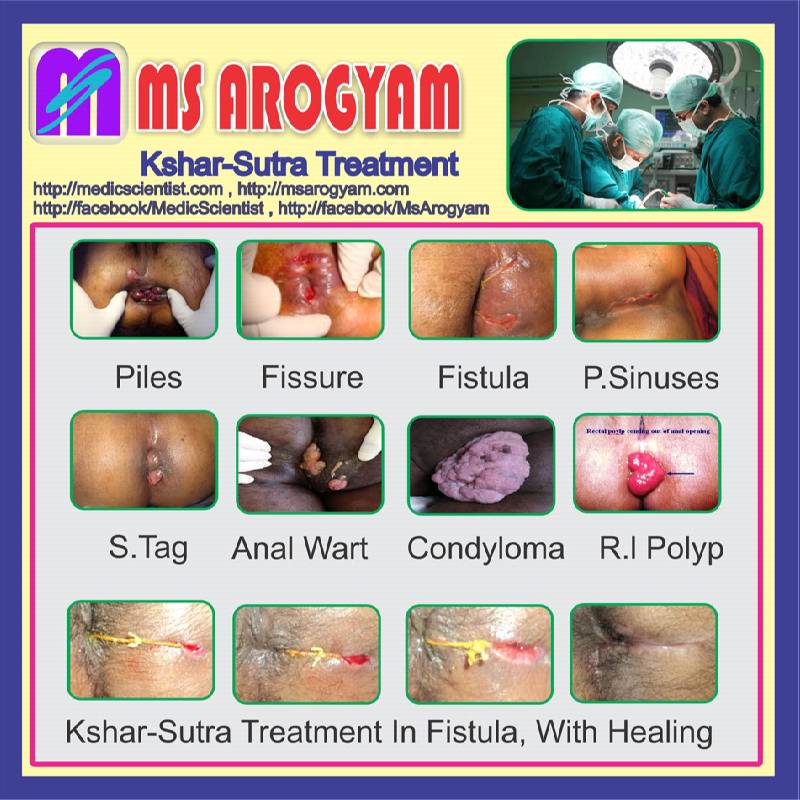


Anal fistula is termed "Bhagandara" in Ayurveda. In Ayurveda fistulas, like other diseases have been classified according to the vitiation of one per more of the three doshas i.e. the vata, the Pitta & the kapha. They have been classified also according to the shape & site of the track of the fistula. Special treatment for such different kinds of fistulas is mention in detail. It is worth noting that the complex & most challenging horse shoe fistula ( complex Ischio-rectal fistula) has been dealt with in detail in Sushruta a classical Ayurveda text) even as early as 300 ad.
The Ksharsutra treatment was probably first advised per this type of fistula named Parikshepi Bhagandara by Sushurta. This Ksharsootra treatment, with a little modification has proved its worth even in modern times.
Anal fistula, a rare condition, is a chronically inflamed, abnormal tunnel between the anal canal and the outer skin of the anus. It often drains watery pus, which can irritate the outer tissues and cause itching and discomfort.
Ayurveda has a unique way of treating fistula in ano. Simple as well as complex fistulas, high anal fistulas, fistulas with multiple track, recurrent fistulas, chron's fistula, tubercular fistula, all respond well to the Ksharsutra ligation procedure.

More Related Links…..:

PREVENTION OF ANAL FISSURES By Ayurveda Treatment

PREVENTION OF ANAL FISSURES
For fissures in adults:
  • Keep the anorectal area dry
  • Wipe the area with soft materials, a moistened cloth, or cotton pad; avoid rough and scented toilet paper
  • Promptly treat all occurrences of constipation and diarrhea
  • Avoid irritating the rectum


AYURVEDA TREATMENT FOR ANAL FISSURES
Ayurveda advises internal medication as well as topical ointment application in the treatment of anal fissures. To avoid further irritation to the damaged tissue, medicines which soften the stools and promote healing of the tissues are utilized. Ointments which are natural anti-bacterial and anti-septic are used for topical application.
COMPLICATIONS OF ANAL FISSURES
Complications of anal fissure can include:
  • Anal fissure that fails to heal. An anal fissure that doesn't heal can become chronic, meaning it lasts for more than six weeks.
  • Anal fissure that recurs. If you've experienced anal fissure once, you have an increased risk of another anal fissure.
  • A tear that extends to surrounding muscles. An anal fissure may extend into the ring of muscle that holds your anus closed (internal anal sphincter). This makes it more difficult for your anal fissure to heal. An unhealed fissure may trigger a cycle of discomfort that may require medications or surgery to reduce the pain and repair or remove the fissure.

ANAL FISSURES Ayurvedic Treatment

ANAL FISSURES

What is a fissure?
An anal fissure is a small tear in the skin that lines the anus. An anal fissure may occur when you pass hard or large stools during a bowel movement. An anal fissure typically causes pain and bleeding with bowel movements.
Anal fissures most often affect people in middle age, but fissures also are the most common cause of rectal bleeding in infants. Most anal fissures heal within a few weeks with treatment for constipation, but some fissures may become chronic


COMMON CAUSES OF ANAL FISSURES
Anal fissures can be caused by trauma to the anus and anal canal. The cause of the trauma can be one or more of the following:
  • Chronic constipation
  • Straining to have a bowel movement, especially if the stool is large, hard, and/or dry
  • Prolonged diarrhea
  • Anal stretching
  • Insertion of foreign objects into the anus
Other causes of anal fissures (other than trauma) include:
  • Longstanding poor bowel habits
  • Overly tight or spastic anal sphincter muscles (muscles that control the closing of the anus)
  • Scarring in the anorectal area
  • Presence of an underlying medical problem: such as Crohn’s disease and ulcerative colitis; anal cancer; leukemia; infectious diseases (such as tuberculosis); and sexually transmitted diseases (such as syphilis, gonorrhea, Chlamydia, chancroid, HIV)
  • Decreased blood flow to the anorectal area
SYMPTOMS OF ANAL FISSURE
Signs and symptoms include:
  • Pain during, and even hours after, a bowel movement
  • Constipation
  • Blood on the outside surface of the stool
  • Blood on toilet
  • A visible crack or tear in the anus or anal canal
  • Burning and itch that may be painful
  • Discomfort when urinating, frequent urination, or inability to urinate
  • Foul-smelling discharge
RISK FACTORS FOR ANAL FISSURES
Factors that may increase your risk of developing an anal fissure include:
  • Infancy. Many infants experience an anal fissure during their first year of life, although experts aren't sure of the reason.
  • Aging. Older adults may develop an anal fissure partly because of slowed circulation, resulting in decreased blood flow to the rectal area.
  • Constipation. Straining during bowel movements and passing hard stools increase the risk of tearing.
  • Childbirth. Anal fissures are more common in women after they give birth.
  • Crohn's disease. This inflammatory bowel disease causes chronic inflammation of the intestinal tract, which may make the lining of the anal canal more vulnerable to tearing